By Dennis van Wanrooij
Being an LGBTI person, a woman or a person of colour greatly increases the risks when travelling abroad. This is not based on academic research, but on something I have observed through my own experience of travelling abroad, both for work and for leisure. Protection for our communities in our own country is already limited; in other countries, it’s out of the question.
In this article, I share a personal account of an incident that happened to me whilst in transit in Doha, Qatar, and highlight some key points about digital safety, offering tips for LGBT people who may face situations of violence at airports or international destinations. Although many destinations still criminalise our very existence and have discriminatory procedures in routine immigration practices, I do not believe the solution is to stop travelling, but rather to take precautions.
In December 2025, I travelled on business to a feminist conference in Nepal, to which I was invited by the organisers, who covered all my expenses. As there are no direct flights between Nepal and Brazil, I opted for the cheapest option, with a stopover in Doha, Qatar, a country in the Middle East. Qatar Airways’ policy allows passengers to stay in Doha for a few days to explore the city at no extra cost. As it was a long flight, I chose this option.
Although I knew it was risky, I knew many people in my community who had already been there and hadn’t encountered any problems. I myself had visited several countries that criminalise LGBTI people, and had never suffered any reprisals as a tourist; on the contrary, I had always been treated well. Tourist status often acts as a kind of poetic licence for the existence of unwanted bodies.
In Qatar, however, things were a little different. Less than 48 hours after landing, I was handcuffed, arbitrarily detained, interrogated for 16 hours, humiliated, deprived of my freedom and food, and expelled from the country.
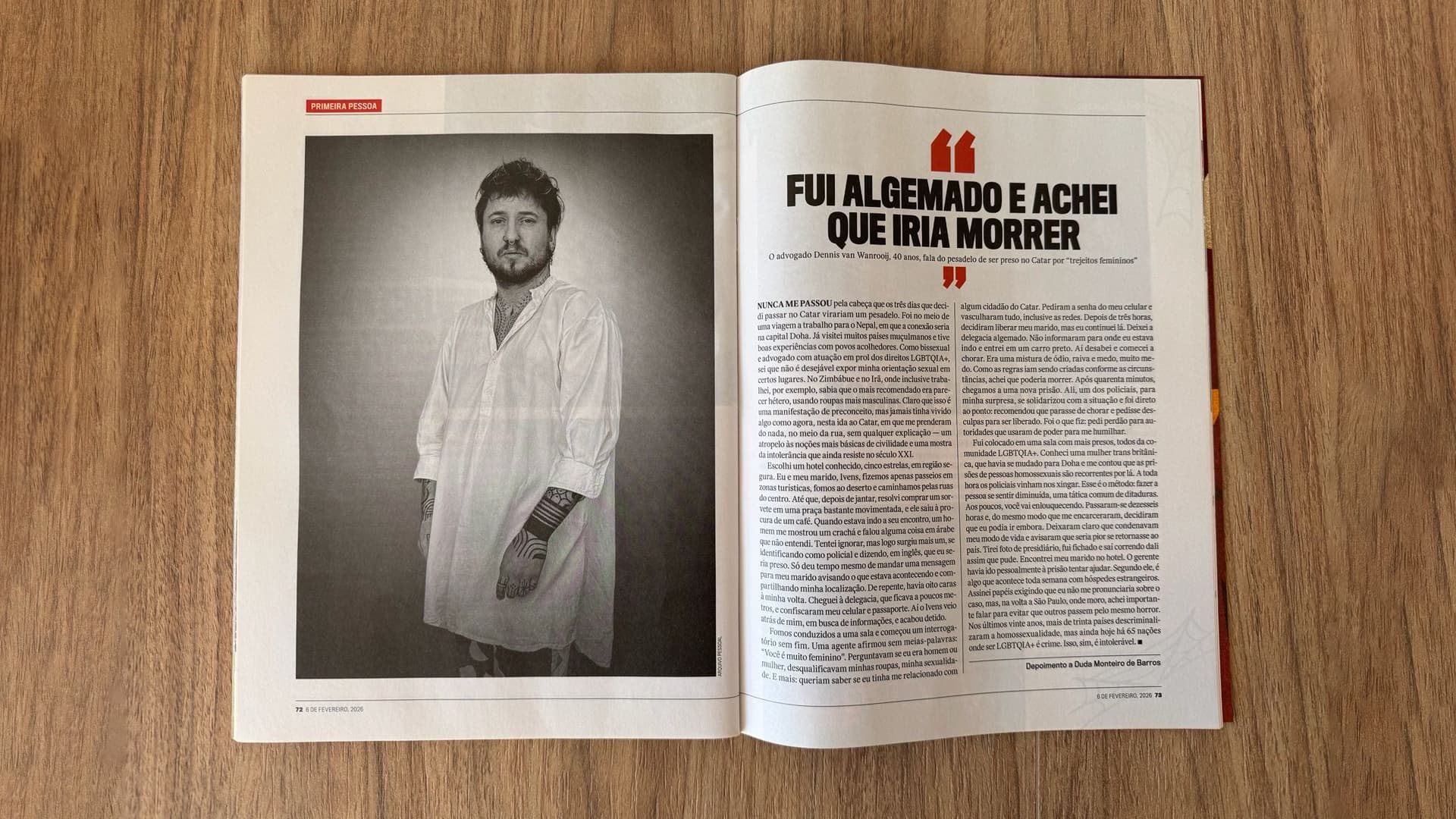
On 5 December 2025, I was walking alone through Souq Waqif — one of Doha’s best-known and most popular tourist markets — when I was surrounded by eight men in plain clothes who identified themselves as police officers. Without any explanation, I was taken to a police station. My passport and mobile phone were confiscated. They demanded my passcode and began searching through my messages, photographs, apps and private conversations.
During this arbitrary detention, many of my human and digital rights were violated, such as the rights to freedom of movement, privacy, psychological integrity and due process.
From the outset, I was denied access to a lawyer and to the embassy. I was alone facing six police officers dressed in religious garb. I argued that I was different from them because I was a tourist and that I was simply shopping on a high street. There was nothing I had done that could be punished, other than my very existence.
Interestingly, the police officers judged me to be queer based on what they found online, particularly on things they had accessed without my permission. As I am a very fluid person, they obviously found online records of times when I was wearing a skirt, make-up or even had my nails done. At the police station, I was wearing shorts, a vest top and a scarf covering my shoulders. At no point did they say my clothing was inappropriate – not at the airport, not at the hotel, nor in the shops. Everything was fine until I was arrested. Unlike in other Arab countries, there are no signs in Doha indicating what is or isn’t permitted to wear.
However, what I was wearing at the police station mattered little, as they had access to my online identity. Once they had illegally accessed my mobile phone, I was, as far as they were concerned, a confessed criminal.
We also know that non-democratic countries have sophisticated online surveillance systems. I believe they carried out an internet search after I entered the country, as I was detained very close to my hotel, which is well known to the police. A simple Google search would have been enough to identify me. And, no doubt, that is exactly what they did. The active persecution of LGBTI people is notorious in Qatar and caused a great deal of outrage during the last World Cup.
The risk, therefore, is not only physical but also digital, and we all face it whilst travelling, even when stopping over in a transit country. The moment you land, the laws of your destination country come into force. What was your right before is no longer so, and everything can be denied.
The various violations I was subjected to during my 16-hour detention in Doha are not relevant here. They were widely reported in major newspapers and magazines, such as O Globo and Veja. I reported the incident to the press as soon as I returned to Brazil.
What is important here is to share a little of my survival strategy and to advise my clients in similar situations.
To get out of a situation like this, first of all, do whatever they ask you to do. Don’t resist. Be friendly. Don’t show any fear. If they don’t give you access to a lawyer or the embassy, as was the case with me, don’t panic. Your relatives will certainly have already contacted professionals and embassies. Therefore, depending on the risk level in the country, never travel alone. At the police station, it’s not the time to get political. There, I was humiliated many times; they told me that being gay is a sin and disgusting, they exposed my explicit content to everyone there, and I simply apologised. I apologised for having offended their culture, which was not my intention. And indeed, it wasn’t. Show understanding of the situation and insist that you are a tourist and just want to return to your own country. I also assured them that I would never return to Qatar. Any act of defiance will only make your situation worse.
After a great deal of composure, hunger (due to being deprived of food) and waiting for help, they released me, and I was served with a court order to leave the country within 24 hours. The police chief said it would be much worse if I didn’t leave or returned to Qatar.
I managed to leave, but after I publicly spoke out about my case in Brazil, several people got in touch with me to say that their children, friends and work colleagues remain imprisoned in Doha to this day. I was very lucky! The most severe cases of detention involve those living with HIV, transgender people and sex workers in Qatar.
In the world of minorities, there is a hierarchy of suffering inflicted by the state, shaped by systems that are utterly authoritarian, inhumane and, above all, moralistic.
Following my public complaint, instead of receiving support and seeing reflection on the contexts that still criminalise people like me, I was subjected to a barrage of LGBT-phobic comments, including from within my own community. As if I deserved that punishment simply for existing and exercising my right to come and go as I please. It is very similar to cases where a woman is raped, yet she is the one blamed.
In my practice, the victim is never to blame.
Cases like this happen every day. This time, it happened to me. However, this can happen to anyone and in many contexts, including in Brazil.
In similar cases, I represent the person whose human and digital rights have been violated, ensuring legal assistance for their family and support in liaising with the Brazilian Ministry of Foreign Affairs. I also produce technical reports and contact institutions abroad, if necessary. Furthermore, I provide guidance on security measures before and after travel, to ensure that accounts are not hacked and that private content is not compromised.
If you would like to know more about my work in this field, please get in touch with me.
My work has been featured in the following media outlets: